Can you build muscle at home? What you really need
What the research says about building muscle without heavy weights, how to make bodyweight moves harder, and when a band, dumbbells or a gym earn their place.
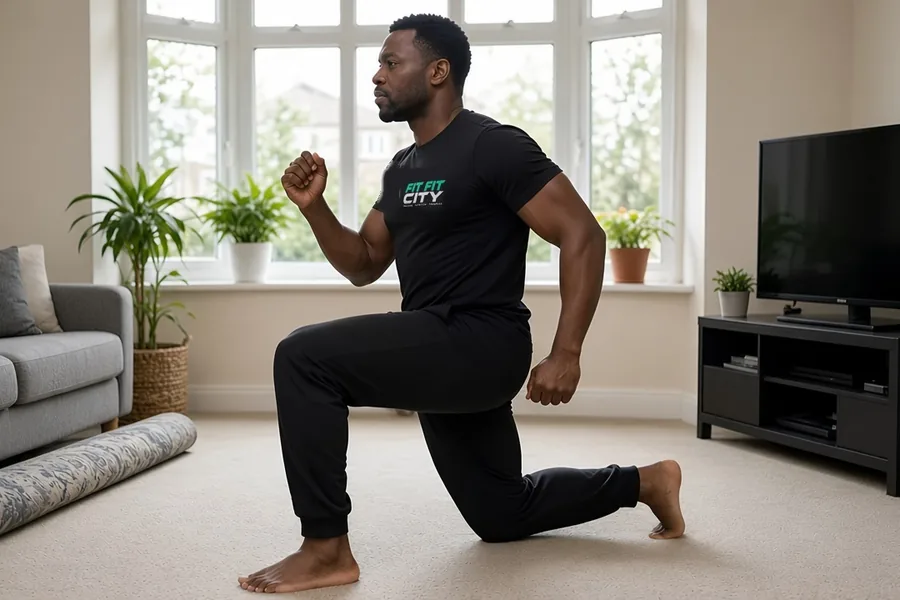
"Can I actually build muscle at home, or am I wasting my time without a gym?" I get asked this a lot, usually by someone with a busy week, a small flat or a dislike of crowded weights rooms. The short answer is yes, you can. The longer answer is that it depends less on the kit and more on how hard you work and whether you keep making things harder.
What muscle actually responds to
Muscle grows when you give it a challenge it isn't used to, then repeat that challenge often enough, nudging it up over time. Heavy barbells are one way to do that. They aren't the only way.
A 2017 review and meta-analysis led by Brad Schoenfeld pulled together 21 studies comparing light loads (60% of your one-rep max or less) with heavy loads. In every study, sets were taken to the point where another rep wasn't possible. Muscle growth was similar between the two. Maximum strength, measured by a one-rep max, improved more with heavy loads.
So for building muscle, effort matters more than the number on the dumbbell. For lifting the heaviest weight you can, heavy training still wins.
Can push-ups do the job
A small Japanese study put this to the test with a move you can do in your living room. Kikuchi and Nakazato split 18 young men into two groups. One did bench press at 40% of their max, the other did push-ups adjusted (for example on the knees) to a similar load. Both trained twice a week for eight weeks.
Both groups gained chest and triceps thickness and bench press strength by a similar amount. The researchers concluded the push-ups were "comparably effective" over the eight weeks.
It's worth being honest about the limits. Eighteen people is a small group, they were all young men, and the study only lasted two months. Muscle thickness on an ultrasound is also an indirect measure. It's encouraging, not the final word.
How to make bodyweight work harder
Here's the practical problem. If you can already do 30 push-ups, the last few reps are probably closer to cardio than to muscle building. The research above relied on sets taken close to failure, so you need ways to make each set genuinely tough.
- Slow the lowering. Take three or four seconds to lower into a squat or push-up. The lowering phase is hard work, as we covered in our post on eccentric training.
- Add range. Push-ups with your hands on two books, or split squats with your front foot on a step, take your muscles further.
- Go single-leg. A Bulgarian split squat puts most of your bodyweight through one leg, which is far harder than a normal squat.
- Pause at the hardest point. Hold the bottom of a squat or push-up for two seconds before coming back up.
- Move up a variation. Progress from an incline push-up against the kitchen worktop to a full push-up on the floor, then to feet raised.
Write down your reps each session. If you beat last week by a rep or two, you're on track. That steady nudge is progressive overload, and it matters more than any single workout.
When a band or dumbbells earn their place
Bodyweight is great for legs, chest and shoulders. It's weaker for pulling muscles like your back and biceps, because there's not much to pull on at home without kit. A resistance band anchored in a door, or a door-frame pull-up bar if your frame suits one, fills that gap cheaply. For the back of your shoulders, a rear delt fly with light dumbbells or two filled water bottles works well at home. With a band anchored at face height, face pulls train the same area.
A pair of adjustable dumbbells helps once single-leg squats get easy at 15 or 20 reps. At that point adding load is quicker than inventing ever harder variations. Dumbbells also open up moves like the Romanian deadlift for your hamstrings and glutes.
A simple home week
Three full-body sessions on non-consecutive days is plenty to start, for example Monday, Wednesday and Friday. Each session could be a squat or split squat, a push-up variation, a hip move such as a glute bridge, a pull with a band, and a plank. Do two or three sets of each, stopping a rep or two before your form breaks. That comfortably covers the NHS advice to do strengthening activities on at least 2 days a week.
If you'd like it laid out for you, our 12-week home workout plan has a bodyweight track and a kit track.
When the gym starts to make sense
Home training can take you a long way. The gym starts to make more sense when you want maximum strength, when your home variations are getting awkward to set up, or when you simply train better around other people. Neither is the "proper" option. The one you'll actually stick to is.
If you have a health condition, an injury or haven't exercised for a while, have a word with your GP or a physio before you start.
This post is general information, not medical advice. If you have a health condition or concerns, speak to your GP or another qualified professional before changing how you eat or exercise. Read our health and fitness disclaimer.
Try FitFitCity free for a week
Start with a free week of full member access: training plans, the workout log, the food diary and 225 recipes. No card needed.
After that, membership is £79 a year, or £9.99 a month on a 12-month minimum.
Start my free weekSee what’s inside